

The Olfactory Pyramid Explained — Top, Heart, Base and Why It Matters
What Is the Olfactory Pyramid?
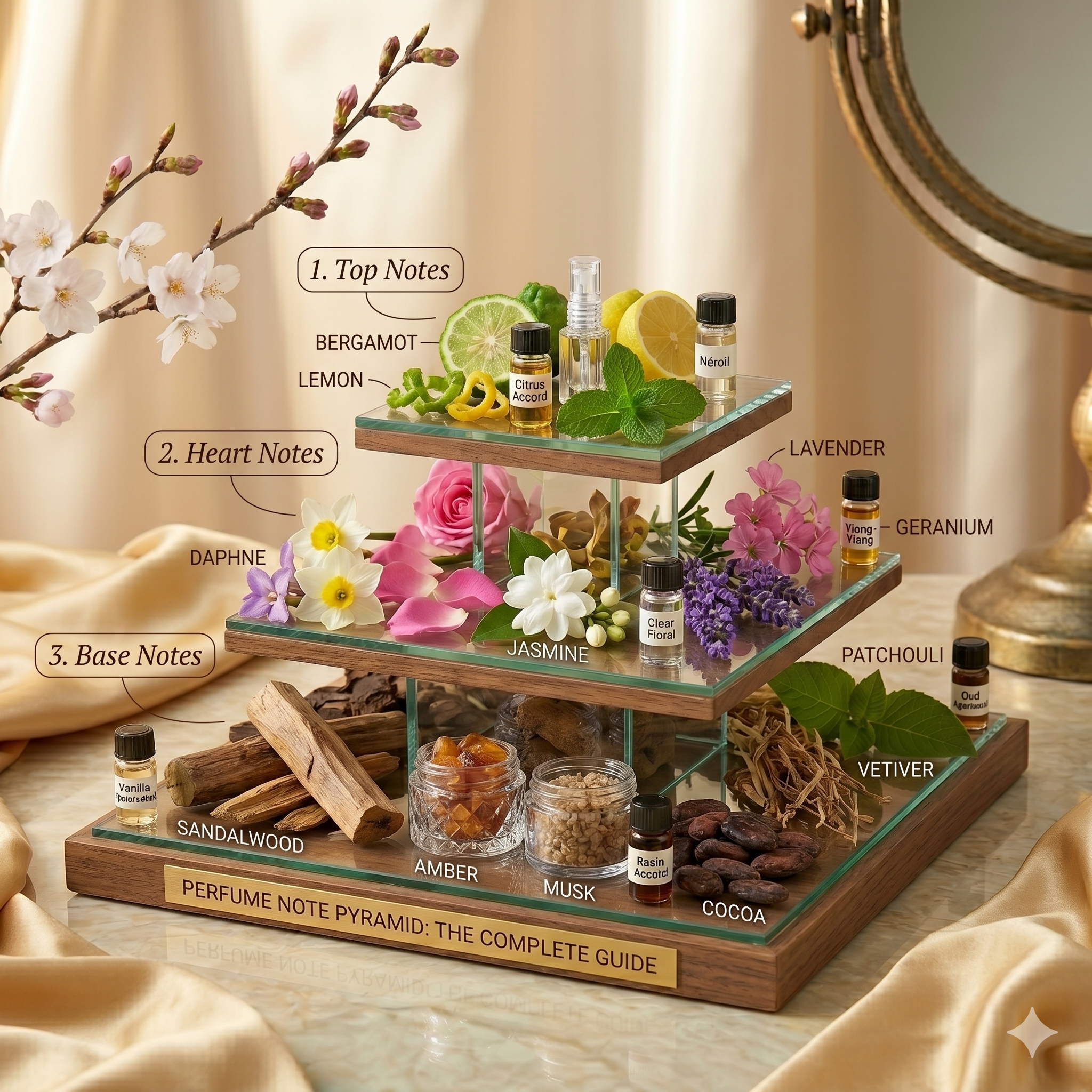
The olfactory pyramid (sometimes called the fragrance pyramid or note pyramid) is the standard way perfumers and brands describe a fragrance's structure. It divides the scent into three layers: top notes, heart notes (also called middle notes), and base notes.
Each layer comes alive at a different time. The fragrance you smell at minute 1 isn't the same as what you smell at hour 4 — and the pyramid tells you why.
The Three Layers Explained
Top Notes — The Opening (0-15 minutes)
The first impression. These are the lightest, most volatile molecules — they evaporate quickly but make the strongest immediate statement.
Common top notes: citrus (bergamot, lemon, grapefruit, mandarin), green notes (galbanum, leaves), light spices (pink pepper, cardamom), aldehydes, light florals.
What top notes do: grab attention. They're what makes you say "I want to try this" in the store.
What they don't do: determine whether you'll love the fragrance long-term. Top notes are designed to seduce; they're not the soul of the perfume.
Heart Notes — The Personality (15 minutes to ~2 hours)
The middle layer. These come alive once the top notes fade and form the dominant impression of the fragrance for the next 1-2 hours.
Common heart notes: florals (rose, jasmine, tuberose, orange blossom, ylang-ylang), spices (cinnamon, clove, cardamom in heavier doses), fruits (apple, pear, fig, plum), green herbs (lavender, sage), tea notes.
What heart notes do: establish character. This is where the fragrance reveals what it actually is.
Base Notes — The Soul (2 hours and beyond)
The deepest, longest-lasting layer. These are the heaviest molecules and they can linger 6-12 hours on skin.
Common base notes: woods (sandalwood, cedar, vetiver, oud), resins (labdanum, benzoin, frankincense), amber accords, musks, vanilla, leather, animalic notes.
What base notes do: determine whether you'll wear it again. The drydown is what stays with you — physically on your skin and emotionally in your memory.
Why the Pyramid Matters for Buying Decisions
1. The 30-second test is misleading
If you've ever bought a fragrance because the opening was incredible, then regretted it after wearing for a few hours — you've experienced this. You bought top notes; you have to wear base notes.
Always test the drydown. Spray, wait 3-4 hours, then decide.
2. You can predict longevity from the pyramid
Fragrances with rich base notes (oud, sandalwood, amber, vanilla, musk) last longer. Fragrances dominated by citrus and light florals tend to fade faster — beautiful but transient.
If you want a long-lasting niche fragrance, look for base notes you love. Examples in our collection: Black Oud Extreme Amber (deep amber + oud base), Ange Noir XXI (dark resinous base), Cocoyster (sandalwood + amber base).
3. You can identify your preferences
People who love certain top notes don't always love the same base notes. The pyramid reveals patterns:
- Love citrus tops + woody bases? You're a fresh-woody person.
- Love fruity hearts + gourmand bases? You're a sweet-warm person.
- Love floral hearts + powdery bases? You're a classic feminine.
- Love spicy hearts + resinous bases? You're an oriental person.
How to Read a Pyramid Listing
When you see a fragrance described like this:
Top: Bergamot, mandarin, pink pepper
Heart: Damascena rose, jasmine, saffron
Base: Oud, amber, sandalwood, musk
You can already predict the experience: bright citrus-spicy opening, transitioning to a rich floral-spicy heart, settling into a deep amber-oud drydown. A classic oriental floral structure.
This is how perfume professionals "read" fragrances without smelling them. With practice, you can too.
The Pyramid Has Limits — Modern Niche Plays With It
The traditional pyramid is a useful framework, but modern niche perfumery sometimes deliberately breaks it. Some examples:
Linear fragrances
Some niche fragrances don't follow the pyramid structure. They open one way and stay that way for hours — "linear" rather than "pyramidal."
Inverted structures
Some compositions start heavy and become lighter, defying the standard top→base evolution.
Multi-stage compositions
Some niche fragrances have 4 or 5 distinct phases instead of 3, with dramatic character shifts over hours.
The pyramid is a map, not the territory. It's accurate for most fragrances, but the best niche compositions sometimes ignore it deliberately.
Apply the Pyramid in Your Next Purchase
Before buying any niche fragrance:
- Look up its note pyramid
- Identify the base notes specifically
- Ask yourself: do I love these on their own?
- Sample on skin and wait at least 4 hours
- Only commit to the bottle if the base resonates
This single habit will save you hundreds of euros in bad purchases over a lifetime of fragrance buying.
Visit Us in Palma
FND SCENTS · Calle Constitución 7, Bajos 18 · 07001 Palma de Mallorca
Monday to Saturday 12:00 – 20:00 · hello@fndscents.com
→ View collection · What Is an Accord? → · Notes Explained →
Kommentare