

How to Store Your Niche Perfume at Home: The Complete Care Guide
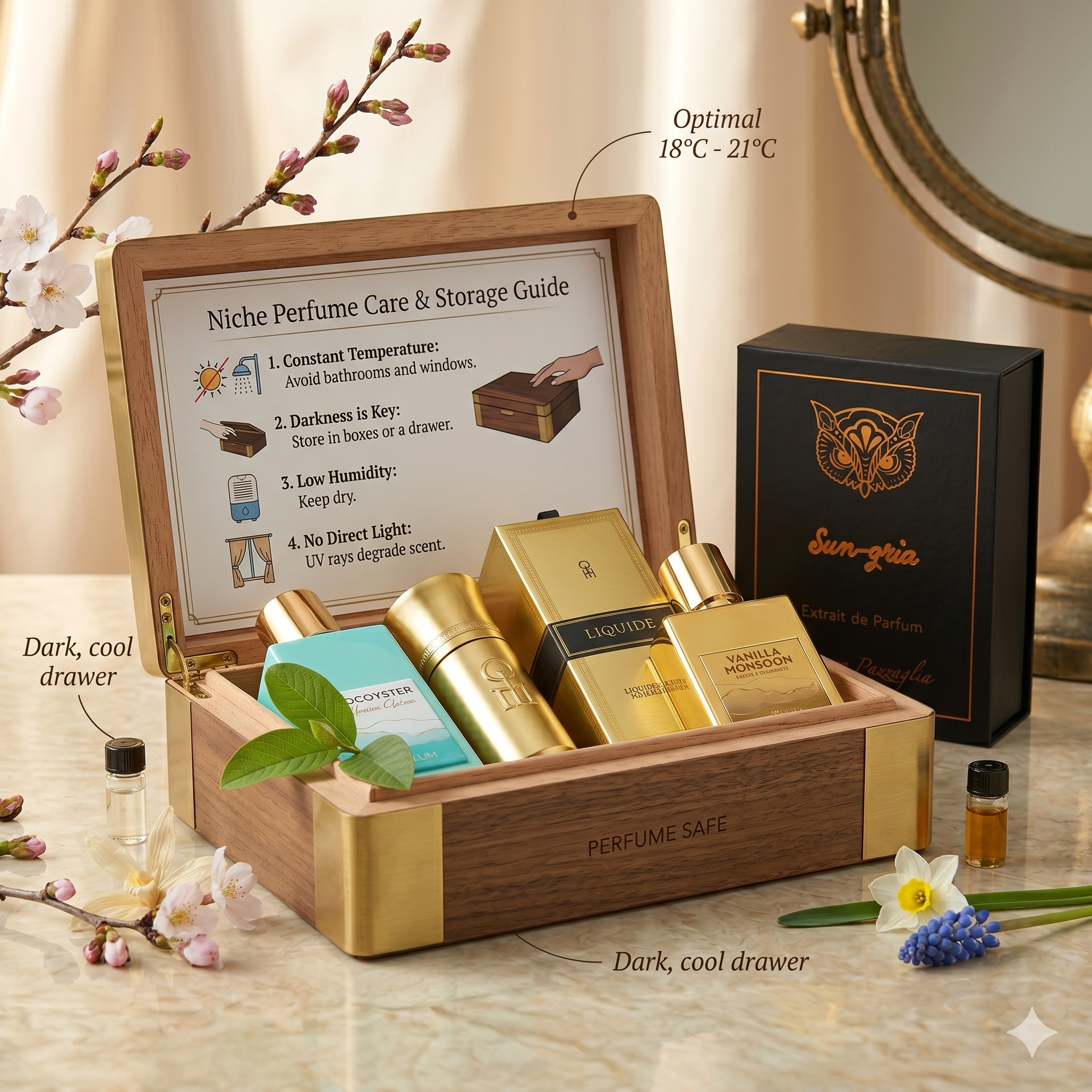
Why Niche Perfume Storage Matters More
A mainstream fragrance that costs €60 and contains largely synthetic ingredients can sit on a bathroom shelf for years without significant degradation. A niche extrait containing natural rose absolute, genuine oud, real woods and costly resins is an entirely different matter. These materials are alive in a chemical sense — they evolve, react and degrade in response to their environment. Protecting a niche perfume collection is not excessive care — it is basic preservation of something valuable.
The Three Enemies of Niche Perfume
1. Light — The Most Damaging Factor
UV and visible light cause photodegradation — chemical reactions that break down fragrance molecules, particularly the natural ingredients that make niche perfumery distinctive.
* What to do: Never display niche perfume on a sunlit windowsill. The original box is the simplest and most effective light protection available — use it.
2. Heat — The Accelerant
Heat accelerates all the chemical reactions that degrade fragrance. The most common mistake: storing perfume in the bathroom, where temperatures regularly exceed 25°C. This is the single worst environment for a niche perfume collection.
* What to do: Store perfume at stable room temperature (ideally 15–20°C). Avoid bathrooms, windowsills, car glove compartments, anything near a radiator.
3. Humidity — The Silent Damage
High humidity doesn't damage the fragrance directly but degrades the bottle and — combined with heat — creates the worst possible storage environment.
*What to do: Keep perfume away from bathrooms and kitchens.
Best Practice: The Wardrobe Method
The simplest and most effective storage solution: keep niche perfume in a bedroom wardrobe, in its original box. This provides all three protective conditions simultaneously — darkness, stable temperature, low humidity.
Extended Storage: Maximising Longevity
- Keep bottles upright. Horizontal storage causes prolonged contact with seals and pump mechanisms.
- Don't shake. Shaking introduces air into the fragrance, which accelerates oxidation.
- Minimise air exposure. Replace caps promptly after use, especially in extrait flacons.
- The refrigerator option. For long-term storage, a dark refrigerator provides ideal conditions: cold, dark and stable.
How Long Does Niche Perfume Last?
| Format | Unopened | After opening (stored correctly) |
|---|---|---|
| Extrait de Parfum | 10+ years | 3–5 years |
| Eau de Parfum | 5–10 years | 2–4 years |
| Eau de Toilette | 3–5 years | 1–3 years |
How to Know If a Perfume Has Turned
✦ Vinegary or sharp smell: Classic sign of oxidation.
✦ Flat or empty quality: The top notes have degraded.
✦ Metallic or chemical notes: The fragrance has begun reacting with its container.
✦ Color change: A clear fragrance that has become noticeably amber-colored may have oxidised significantly.
Get Expert Advice at FND SCENTS
At FND SCENTS in Palma de Mallorca, we're happy to advise on any aspect of niche perfume care, storage and longevity.
📍 FND SCENTS · Calle Constitución 7, Bajos 18 · 07001 Palma de Mallorca
🕒 Monday to Saturday 12:00 – 20:00 · 📧 hello@fndscents.com
Fragrance Notes Explained → · What is Extrait de Parfum? → · Best Niche Perfumes for Travel →
Kommentare