

Fragrance Notes Explained: Top, Heart and Base — The Complete Guide
What Are Fragrance Notes?
A fragrance note is a single scent element within a composition — one ingredient, or a blend of ingredients that read as a unified impression. When you smell a perfume and detect "rose" or "cedar" or "vanilla," you are detecting notes. But notes are not simply ingredients: they are also the language used to describe what a perfume smells like at different stages of wear.
Every fragrance changes over time on your skin. The perfume you smell on first spray is not the same perfume you'll be wearing four hours later. Understanding how notes work transforms how you experience and choose fragrance — and explains why sampling on your own skin is the only reliable way to know if a niche perfume is right for you.
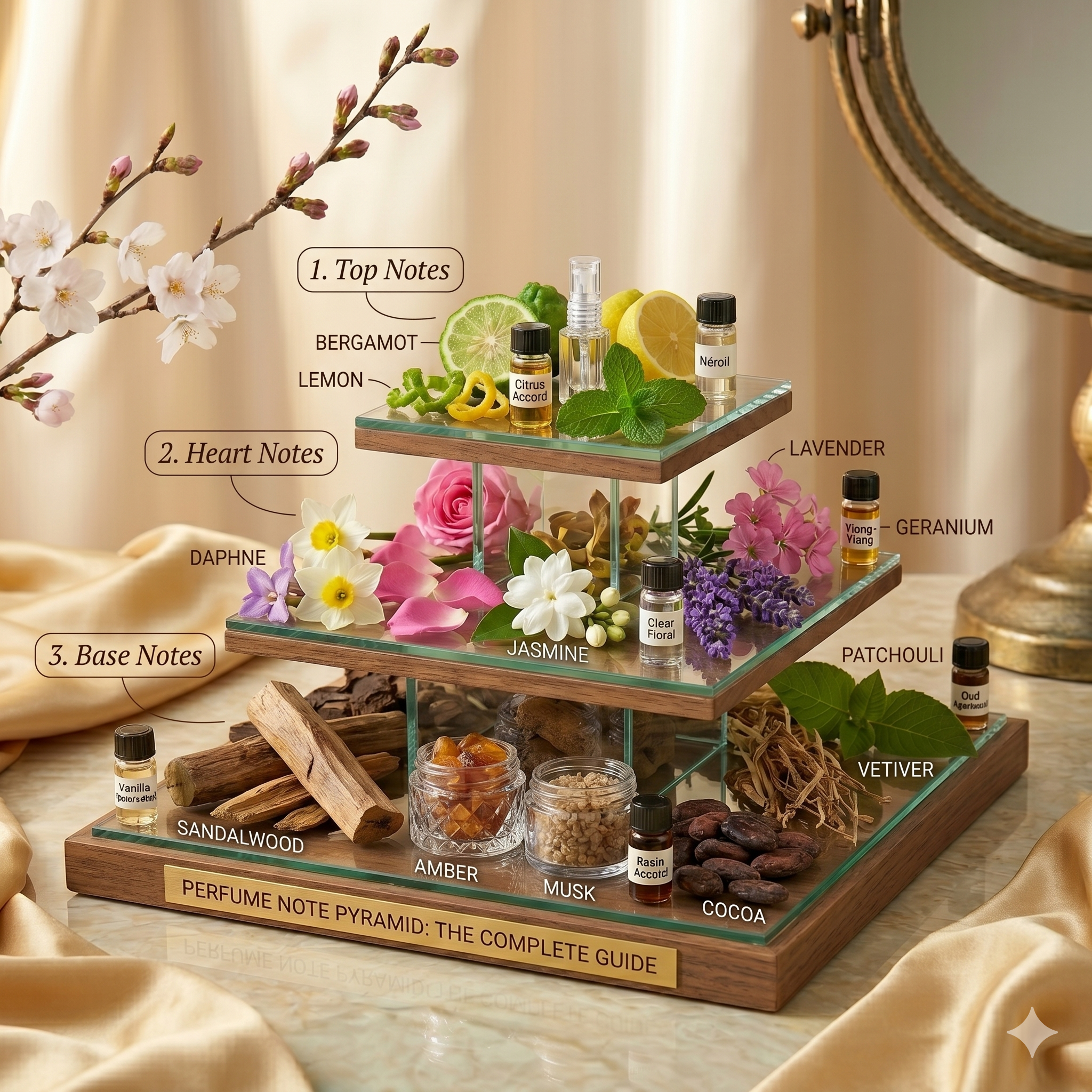
The Fragrance Pyramid
Top Notes — The Opening (0–30 minutes)
The first impression of a fragrance. Top notes are typically light, volatile molecules that evaporate quickly: citrus, herbs, light spices, ozonic accords. They are the least representative part of any fragrance. Never judge a niche perfume on its first five minutes.
Heart Notes — The Character (30 minutes – 4 hours)
The core of the fragrance — what emerges after the top notes have evaporated and the composition settles into its true identity. Heart notes typically include florals, spices, woods and more complex aromatic materials. This is where a perfumer's vision lives most completely.
Base Notes — The Drydown (4+ hours)
The foundation that underpins the entire composition. Base notes are heavy, slow-evaporating molecules: musks, woods (sandalwood, cedarwood, vetiver), resins (amber, labdanum, benzoin), and rich materials like vanilla, oud and patchouli. The drydown is where niche perfumery often surprises most.
How Notes Work in Practice
Think of it like a novel. The top notes are the opening paragraph — they set the scene. The heart notes are the main narrative. The base notes are the ending: what you remember, what lingers, what makes you reflect on the whole experience.
Why Niche Perfumery Is Different
Mainstream fragrance is typically optimised for impact on first spray. Niche perfumery inverts this: the emphasis is on the heart and base. The opening may be quiet, even underwhelming. The drydown is where the investment in quality raw materials becomes apparent.
Fragrance Notes in Our Selection: Examples
✦ Linear and immediate: Sparkling Tamarind (Salum)
✦ Evolves beautifully: Gong (Floraïku) — quiet opening, extraordinary depth after 30–60 minutes
✦ Exceptional drydown: Royal Bourbon (Plume Impression)
✦ Skin-close evolution: Sand and Skin (Floraïku)
✦ Concentrated base-first: Black Oud Extreme Amber (Laurent Mazzone)
How to Use This Knowledge When Testing
- Apply to skin and smell immediately. Note the top notes — but don't judge.
- Wait 30 minutes. The heart is now emerging. Spend most of your evaluation here.
- After 2–4 hours, check the base notes. How has the fragrance changed?
- After 6–8 hours, this is the skin trace — the memory the fragrance leaves.
Test Niche Perfumery at FND SCENTS
At FND SCENTS in Palma de Mallorca, we carry samples of every fragrance we stock. The only way to understand notes properly is to wear them.
📍 FND SCENTS · Calle Constitución 7, Bajos 18 · 07001 Palma de Mallorca
🕒 Monday to Saturday 12:00 – 20:00 · 📧 hello@fndscents.com
What is Extrait de Parfum? → · What is Niche Perfumery? → · Best Niche Fragrances for Beginners →


Comments